
In This Article:
- How tick-borne diseases became the most common vector illnesses in the U.S.
- The historical deforestation and deer explosion fueling Lyme disease
- Why California’s fragmented housing patterns worsen tick risk
- The untold story of cattle fever and the USDA’s tick-fighting strategy
- Global examples of human-tick coevolution and public health consequences
Ticks and Lyme Disease -- The Surprising Role Humans Play
by Sean Lawrence, West Virginia University
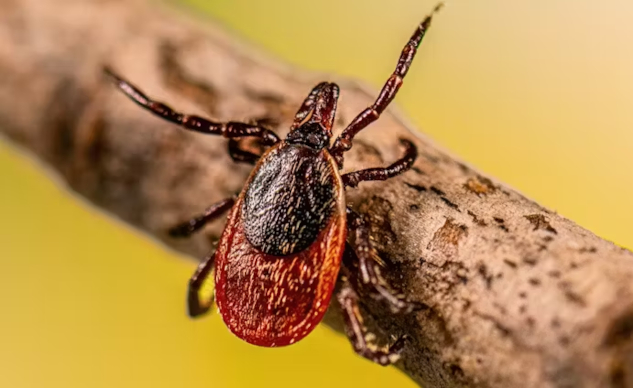
When you think about ticks, you might picture nightmarish little parasites, stalking you on weekend hikes or afternoons in the park.
Your fear is well-founded. Tick-borne diseases are the most prevalent vector-borne diseases – those transmitted by living organisms – in the United States. Each tick feeds on multiple animals throughout its life, absorbing viruses and bacteria along the way and passing them on with its next bite. Some of those viruses and bacteria are harmful to humans, causing diseases that can be debilitating and sometimes lethal without treatment, such as Lyme, babesiosis and Rocky Mountain spotted fever.
But contained in every bite of this infuriating, insatiable pest is also a trove of social, environmental and epidemiological history.
In many cases, human actions long ago are the reason ticks carry these diseases so widely today. And that’s what makes ticks fascinating for environmental historians like me.

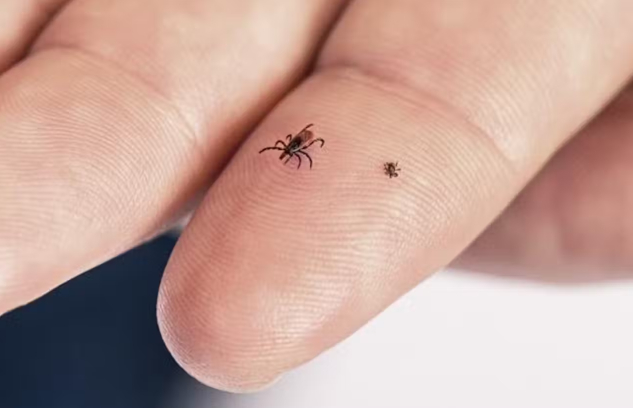
Ticks can be tiny and hard to spot. This is an adult and nymph Ixodes scapularis on an adult’s index finger.
Changing forests fueled tick risks
During the 18th and 19th centuries, settlers cleared more than half the forested land across the northeastern U.S., cutting down forests for timber and to make way for farms, towns and mining operations. With large-scale land clearing came a sharp decline in wildlife of all kinds. Predators such as bears and wolves were driven out, as were deer.
As farming moved westward, Northeasterners began to recognize the ecological and economic value of trees, and they returned millions of acres to forest.
The woods regrew. Plant-eaters such as deer returned, but the apex predators that once kept their populations in check did not.
As a result, deer populations grew rapidly. With the deer came deer ticks (Ixodes scapularis) carrying borrelia burgdorferi, the bacterium that causes Lyme disease. When a tick feeds on an infected animal, it can take up the bacteria. The tick can pass the bacteria to its next victim. In humans, Lyme disease can cause fever and fatigue, and if left untreated it can affect the nervous system.
The eastern U.S. became a global hot spot for tick-borne Lyme disease starting around the 1970s. Lyme disease affected over 89,000 Americans in 2023, and possibly many more.
Californians move into tick territory
For centuries, changing patterns of human settlements and the politics of land use have shaped the role of ticks and tick-borne illnesses within their environments.
In short, humans have made it easier for ticks to thrive and spread disease in our midst.
In California, the Northern Inner Coast and Santa Cruz mountain ranges that converge on San Francisco from the north and south were never clear-cut, and predators such as mountain lions and coyotes still exist there. But competition for housing has pushed human settlement deeper into wildland areas to the north, south and east of the city, reshaping tick ecology there.
While western black-legged ticks (Ixodes pacificus) tend to swarm in large forest preserves, the Lyme-causing bacterium is actually more prevalent in small, isolated patches of greenery. In these isolated patches, rodents and other tick hosts can thrive, safe from large predators, which need more habitat to move freely. But isolation and lower diversity also means infections are spread more easily within the tick’s host populations.
People tend to build isolated houses in the hills, rather than large, connected developments. As the Silicon Valley area south of San Francisco sprawls outward, this checkerboard pattern of settlement has fragmented the natural landscape, creating a hard-to-manage public health threat.
Fewer hosts, more tightly packed, often means more infected hosts, proportionally, and thus more dangerous ticks.

Six counties across these ranges, all surrounding and including San Francisco, account for 44% of recorded tick-borne illnesses in California.
A lesson from Texas cattle ranches
Domesticated livestock have also shaped the disease threat posed by ticks.
In 1892, at a meeting of cattle ranchers at the Stock Raiser’s Convention in Austin, Texas, Dr. B.A. Rogers introduced a novel theory that ticks were behind recent devastating plagues of Texas cattle fever. The disease had arrived with cattle imported from the West Indies and Mexico in the 1600s, and it was taking huge tolls on cattle herds. But how the disease spread to new victims had been a mystery.
Editors of Daniel’s Texas Medical Journal found the idea of ticks spreading disease laughable and lampooned the hypothesis, publishing a satire of what they described as an “early copy” of a forthcoming report on the subject.
The tick’s “fluid secretion, it is believed, is the poison which causes the fever … [and the tick] having been known to chew tobacco, as all other Texans do, the secretion is most probably tobacco juice,” they wrote.
Fortunately for the ranchers, not to mention the cows, the U.S. Department of Agriculture sided with Rogers. Its cattle fever tick program, started in 1906, curbed cattle fever outbreaks by limiting where and when cattle should cross tick-dense areas.
By 1938, the government had established a quarantine zone that extended 580 miles by 10 miles along the U.S.-Mexico border in South Texas Brush Country, a region favored by the cattle tick.
This innovative use of natural space as a public health tool helped to functionally eradicate cattle fever from 14 Southern states by 1943.
Ticks are products of their environment
When it comes to tick-borne diseases the world over, location matters.
Take the hunter tick (Hyalomma spp.) of the Mediterranean and Asia. As a juvenile, or nymph, these ticks feed on small forest animals such as mice, hares and voles, but as an adult they prefer domesticated livestock.
For centuries, this tick was an occasional nuisance to nomadic shepherds of the Middle East. But in the 1850s, the Ottoman Empire passed laws to force nomadic tribes to become settled farmers instead. Unclaimed lands, especially on the forested edges of the steppe, were offered to settlers, creating ideal conditions for hunter ticks.
As a result, farmers in what today is Turkey saw spikes in tick-borne diseases, including a virus that causes Crimean-Congo hemorrhagic fever, a potentially fatal condition.
Where to check for ticks and how to remove them.
It’s probably too much to ask for sympathy for any ticks you meet this summer. They are bloodsucking parasites, after all.
Still, it’s worth remembering that the tick’s malevolence isn’t its own fault. Ticks are products of their environment, and humans have played many roles in turning them into the harmful parasites that seek us out today.
About the Author
Sean Lawrence, Assistant Professor of History, West Virginia University
This article is republished from The Conversation under a Creative Commons license. Read the original article.
Books on The Environment from Amazon's Best Sellers list
"Silent Spring"
by Rachel Carson
This classic book is a landmark in the history of environmentalism, drawing attention to the harmful effects of pesticides and their impact on the natural world. Carson's work helped to inspire the modern environmental movement and remains relevant today, as we continue to grapple with the challenges of environmental health.
Click for more info or to order
"The Uninhabitable Earth: Life After Warming"
by David Wallace-Wells
In this book, David Wallace-Wells offers a stark warning about the devastating effects of climate change and the urgent need to address this global crisis. The book draws on scientific research and real-world examples to provide a sobering look at the future we face if we fail to take action.
Click for more info or to order
"The Hidden Life of Trees: What They Feel, How They Communicate?Discoveries from A Secret World"
by Peter Wohlleben
In this book, Peter Wohlleben explores the fascinating world of trees and their role in the ecosystem. The book draws on scientific research and Wohlleben's own experiences as a forester to offer insights into the complex ways that trees interact with one another and the natural world.
Click for more info or to order
"Our House Is on Fire: Scenes of a Family and a Planet in Crisis"
by Greta Thunberg, Svante Thunberg, and Malena Ernman
In this book, climate activist Greta Thunberg and her family offer a personal account of their journey to raise awareness about the urgent need to address climate change. The book provides a powerful and moving account of the challenges we face and the need for action.
Click for more info or to order
"The Sixth Extinction: An Unnatural History"
by Elizabeth Kolbert
In this book, Elizabeth Kolbert explores the ongoing mass extinction of species caused by human activity, drawing on scientific research and real-world examples to provide a sobering look at the impact of human activity on the natural world. The book offers a compelling call to action to protect the diversity of life on Earth.
Click for more info or to order
alArticle Recap:
This article explores how human land use, historical settlement patterns, and environmental changes have amplified the risks of tick-borne diseases like Lyme and cattle fever. It reveals the deep ties between ecological disruption and rising public health threats from ticks across the U.S. and beyond.
#ticks #LymeDisease #tickborneillness #environmentalhistory #publichealth #wildlifeecology #climateandhealth #urbanization #tickprevention #innerselfcom