Vibration machines promise significant fitness benefits with minimal effort, claiming that just ten minutes of use equals an hour of traditional exercise. However, evidence supporting these claims is mixed, particularly concerning weight loss. While some studies suggest benefits for certain populations, more research is needed to validate the effectiveness of these machines for general fitness.
In This Article
- What are the claims about vibration machines?
- How does whole body vibration therapy work?
- Can vibration machines enhance weight loss?
- What are the health benefits of vibration therapy?
- What are the limitations of vibration machines?
Vibration machines have popped up in gyms alongside traditional equipment, and manufacturers claim ten minutes of vibration a day can be equivalent to an hour spent working out. Standing on a rapidly shaking platform will, according to claims, improve muscle tone and circulation, and accelerate weight loss. 
It’s an appealing prospect: passively standing on a platform and doing, well nothing, while your body seemingly tones and loses weight on its own. But is there evidence these vibration machines actually work as they say they do?
How does it work?
Whole body vibration therapy was initially developed for athletes to improve the effectiveness of their training. Vibration platforms would be included in some regular conditioning and gym exercises such as squats, press-ups and step-ups.
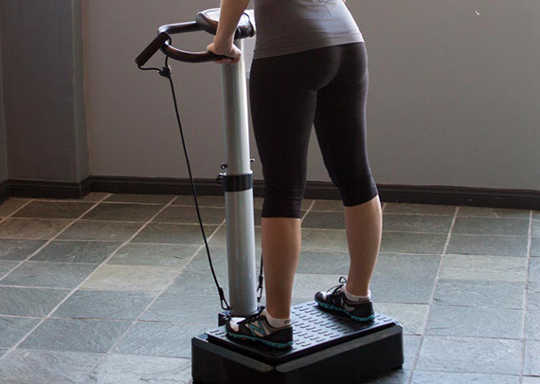
The therapy is undertaken by standing, sitting, lying or doing exercises on specifically designed equipment that oscillates, generally in a horizontal plane, at relatively high frequencies.

The theory is that the vibration signals are transferred into body tissues, tendons and muscles, which increases muscle contractions and ultimately improves muscle strength, co-ordination and balance. In the long term, such contractions would increase muscle mass and energy expenditure, leading to better control of blood sugar levels.
Current theory also suggests bone cells are sensitive to this vibration and respond by increasing bone density. This has a further impact on better sugar control.
But these are still theories. The overall effects of whole body vibration therapy remain elusive, as scientific studies vary largely in the vibration parameters used.
A recent study comparing whole body vibration with exercise in male mice specifically bred to be become obese and diabetic showed whole body vibration was equivalent to exercise for improving muscle quality, control of blood sugar and improving bone health.
It was also equivalent in reducing fat tissue – especially in the abdomen, which is known as “bad” fat. But caution should be exercised when applying findings from this or any other animal study directly to humans.
Can it enhance weight loss?
There are a number of significant differences between humans and mice. These include size and gait (two legs compared to four). The vibration protocol for rodents would also have likely been more extreme compared to what humans could safely tolerate.
A review of trials for whole body vibration therapy in humans showed the outcomes were far less convincing. Whole body vibration therapy alone (without exercise) – usually three times per week, ten to 60 minutes per day over periods of six to 52 weeks – does not support meaningful weight loss (considered to be more than 5% body weight).
While small individual studies report weight loss, their methodologies often combine diets or other exercises. Such benefits are rarely seen with whole body vibration therapy alone.
However, isolated whole body vibration therapy in similar time doses (30 to 60 minutes) does promote physical conditioning, muscle strength, bone health and functional capacity to a similar extent as the currently recommended 30 to 60 minutes of light to moderate exercise per day.
Other health benefits
Whole body vibration therapy has now been tested as a potential stand-alone therapy in a number of patient groups where their mobility, capacity or desire to undertake exercise is limited but it is a recommended therapy.
These groups include those who have suffered cerebrovascular events like a stroke; those with osteoarthritis where mobility is limited; those with chronic obstructive pulmonary diseases who find exercising difficult as they struggle to breathe; and those with type 2 diabetes and post-menopausal women who may have limited motivation to undertake exercise.
The studies found benefits of whole body vibration therapy in these groups. But it was limited to improved bone health and capacity to walk or transitioning from a seated to standing position. These outcomes ultimately reduce risk of falls and fractures, and increase capacity to undertake activities of daily living.
So this means body vibration may have a role in preventing weight gain and improving functional capacity and bone health in groups of people where normal exercise or physical activities are significantly impaired. More rigorous research is still needed.
Overall, if you’re physically able, you’ll have far more benefits taking a 30-minute walk with friends, or engaging in 30 minutes of outdoor activities in the backyard or park with your family, rather than standing in one place being vibrated for 30 to 60 minutes.
About The Author
Nigel Stepto, Associate Professor in Exercise Physiology and Research Associate of Institute of Sport Exercise and Active Living (ISEAL), Victoria University
This article was originally published on The Conversation. Read the original article.
Further Reading
-
Exercised: Why Something We Never Evolved to Do Is Healthy and Rewarding
This book fits the article because it takes a clear-eyed look at what exercise really does for the body and how marketing often distorts our expectations. It helps readers think more critically about shortcuts, passive fitness claims, and the difference between movement that is genuinely beneficial and movement that is merely packaged as convenient. That makes it a strong companion to an article questioning vibration-machine promises.
Amazon: https://www.amazon.com/exec/obidos/ASIN/B087NFK9HC/innerselfcom
-
ACSM's Guidelines for Exercise Testing and Prescription
This is a useful follow-up for readers who want a more grounded understanding of what evidence-based exercise looks like. It contrasts well with the article’s skepticism toward exaggerated fitness claims by focusing on tested principles of conditioning, strength, and physical function. Readers comparing vibration therapy to conventional exercise will benefit from that broader framework.
Amazon: https://www.amazon.com/exec/obidos/ASIN/B004XSKOFQ/innerselfcom
-
Younger Next Year for Women: Live Strong, Fit, and Sexy - Until You're 80 and Beyond
This title complements the article’s conclusion that ordinary, consistent movement usually offers more real-world benefit than passive alternatives. It emphasizes sustainable activity, strength, mobility, and healthy aging rather than quick fixes. That makes it especially relevant for readers interested in bone health, functional capacity, and long-term well-being.
Amazon: https://www.amazon.com/exec/obidos/ASIN/0761147748/innerselfcom
Article Recap
Vibration machines may improve muscle strength and bone health, particularly for those unable to engage in traditional exercise. However, they are not a substitute for regular physical activity, which offers more comprehensive health benefits.
#InnerSelfcom #VibrationTherapy #MuscleStrength #BoneHealth #WeightManagement #ExerciseAlternatives