
Please use this link to subscribe to our YouTube Channel. By subscribing and watching the video, you are helping support the InnerSelf.com website. Thank you.
Precognition and Intuition Are Hardwired Into Your DNA
by Theresa Cheung, author of the book: Dreaming of Your Future.

Sensing things beyond time and the material realm is far more common than you may think. Indeed, many researchers and scientists in this area are concluding that precognitive experiences are the norm and not the exception. Our sixth sense is encoded in our DNA.
Also encoded in our DNA is an instinct that we are part of something greater than ourselves.
In ancient times when we were at the mercy of super predators, our lives depended on our innate sixth sense, but the march of industrialisation, technology, and rationalism has made us forget how to use it. We place our physical senses on a pedestal, as if they create our experience of life, but this could not be further from the truth.
What You Believe Matters
We create the world through our invisible senses. Precognition is an instinct within everyone, and we all can remember and activate it. The problem is the barrier of doubt and fear that has built up over the centuries and made us mistrust it and therefore ourselves.

Research strongly indicates that those who believe precognition is real are far more likely to have accurate precognitions than those who doubt it.
The clear message here is that you dramatically increase your chances of having precognitive experiences if you believe in precognition, or at the very least keep your mind open to the possibility.
Precognitive Personality Characteristics
Although belief in precognition is by far the most dominant characteristic of people who have accurate precognitions, certain other characteristics have come to the fore in studies. I’ll share them here because they are intriguing, but do bear in mind that the association is slight. They are just potential indicators from small rather than large-scale studies and are by no means written in stone.
There seems to be no bias when it comes to gender differences and precognitive accuracy, although some preliminary data suggests that hormonal changes in women may impact their precognitive performance.
One leading characteristic to emerge is an adventurous approach to life, which means being open to new experiences: a seeker of knowledge who believes change, rather than routine, is the spice of life.
There could be a connection between accurate precognition and extraversion, assertiveness, and sociability. Rest assured, though, if you are (like me) more of an introvert who values your quiet, that there really is not enough evidence yet from research to suggest a one-size-fits-all precognitive personality type.
Tentative research suggests a link between sixth sense and being born into a spiritually/religiously inclined family as well as childhood trauma, autoimmune disorders, and being left-handed.
There is a demonstrable link between unconditional love for yourself and precognitive experiences in dreams and waking life. In other words, self-compassion and self-respect are key in both your precognitive dream-work and your life.
Over the decades that I have been collating true life stories about precognitive experiences, I have noticed that many people who contact me fall squarely in the introvert category. I have also noticed, in my nonscientific analysis of data sent to me, that many of these individuals are empathetic, compassionate, and creative people who would probably score high on the Highly Sensitive Person Scale, a scale that psychologists use to identify people with highly sensitive traits, namely empathy, intuition, and creativity.
Sensitive Souls
According to psychologists, around 20 percent of people identify with highly sensitive personality traits. They live their lives constantly alert to what they can’t see or explain rationally but that they sense empathetically and intuitively, a.k.a. precognitively.
This doesn’t mean the remaining 80 percent are a lost cause. It just means there is a spectrum of sensitivity. Even those labelled insensitive experience times in their lives when their innate sensitivity is activated, typically by acute stress or loss.
Sensitive personality traits have likely evolved and remained innate because they are crucial for survival, with intuition helping us be alert to potential threats and empathy encouraging us to take care of each other. High sensitivity can also run in families, but whether you identify strongly with highly sensitive personality traits or not, be aware that the potential for sensitivity is always there in your DNA, even if it is hidden or you don’t quite believe in it yet.
Highly sensitive people will likely be more instinctive in their precognition, but a serious challenge for highly sensitives is setting boundaries to limit sensory overload. They need to filter out what is relevant from what is not in the endless flood of invisible potentially precognitive messages they pick up on.
The challenge for those who identify as less sensitive—and therefore less inclined to believe precognition is real—is to awaken precognitively in the first place. But when so-called insensitive individuals do open their minds to the reality of precognition, the messages they sense tend to be clearer and more convincing than for those who are highly sensitive.
In a nutshell, whether you consider yourself highly sensitive or not, whether you believe in precognition or not, you can still awaken precognitively. You just need to approach your precognition training in a different way. The game changer for everyone, especially those who consider themselves to be insensitive, appears to be meditation.
Inner Calm
When the brains of people who say they are not precognitive are studied, it seems that the parts of the brain associated with being highly sensitive (in the right hemisphere) don’t light up in the same way they do in those who are more open to precognition. But when a simple course of daily meditation is followed for at least three weeks, those “precognitive” brain parts do start to ignite with greater intensity.
Research on monks shows that there is a correlation between the number of years of regular meditation and precognitive brain activity. This is incredibly helpful research to know about if you are sceptical and want to find a way to start trusting in and activating your own precognitive potential. A course of daily meditation might just do the trick.
While meditation, or calming your mind, sounds simple, it can be anything but, as our minds have a natural tendency to roam. That’s a great thing, as mind wandering is often the door to precognitive insight, but only if you know how to notice and then observe that insight. That’s where meditation comes in. It helps you detach from your thoughts without judgement so you can notice whatever precognitive guidance and feelings arise.
Not only does meditation activate the creative parts of your brain, but it can also boost your concentration and problem-solving abilities. Students who meditate regularly are more likely to graduate.
Other studies show that meditation can change how your mind works and help you deal more calmly with stress — more reasons why it is so good for your precognition training, as stress and poor concentration are precognitive roadblocks.
If meditation doesn’t come naturally to you because your mind is constantly preoccupied, you are not alone. Many people struggle with meditation. I struggle with it, and the reason for my struggle is that I tend to focus too much on the end goal of clearing or calming my mind and not on the experience itself.
I constantly need to remind myself that meditation isn’t the absence of thought, as thoughts never cease to flow, but rather it’s being aware of those thoughts but not identifying or interacting with them. It isn’t zoning out of your thoughts or controlling them or stopping their endless stream in your mind; it is observing them, watching them flow past, without interaction, expectation, or judgment. Compare it to sitting beside a stream and simply watching the movement of the water as it flows by.
There Is No Right Way To Meditate
You are strongly advised to meditate every day. It’s a key part of your precognitive-boosting action plan, but don’t panic if it feels like another item on your to-do list, as it need only take a few minutes.
You’ll find a bewildering array of meditation techniques out there, many of which make it sound far more complicated and time-consuming than it is. Experiment if you like, but if you find yourself forcing or straining for results, please stop. There really is no right way to meditate.
If you are new to meditation, just think about it as your time to recharge. You plug your phone in every day to recharge, so do the same for yourself. You don’t need to set aside acres of time or go on a retreat or learn complicated techniques. You can meditate effectively in under two minutes. Give it a try now.
Your Daily Meditation
Simply set a timer for two minutes and then find somewhere safe and quiet where you can sit comfortably. Now close your eyes gently and observe your thoughts and feelings without judgment or interaction.
Your thoughts won’t stop during those two minutes, but your internal dialogue with them will, because you are choosing to notice them but not answer or expect anything from them. Watch those thoughts, and the energies they create within you, fly by.
When the two minutes are up, congratulate yourself. You have taken some time out from the tyranny of your thoughts and reminded yourself that you are not your thoughts. They do not define or control you. Your thoughts are separate from who you are. You decide which thoughts you are going to entertain or not. You get to choose what you want to think about.
You can extend your meditation time to five, ten, or twenty minutes, but this is not essential.
You can also try a two-minute breath meditation, where instead of observing your thoughts, you simply focus all your attention on the flow and feel of your breath. It’s well known that deep breathing from the stomach rather than the chest is optimal for our holistic well-being, so setting aside two minutes to simply make a conscious effort to breathe more deeply can be an instant calmer.
As you slowly breathe out from your stomach and through your mouth, imagine you are exhaling tension. Totally empty your lungs, and when they are empty, pause a bit before inhaling. Then, as you inhale deeply through your nose, imagine you are breathing in calm. Focus your thoughts on the different feelings of your inhale and your exhale. If your mind wanders (and it will, because that is what our minds are programmed to do), just bring your attention back to the flow of your breath.
Alternatively, you can choose a calming mantra—typically one word, such as peace, love, or future—to say out loud repeatedly for two minutes. Concentrate your attention on how saying that word feels and the energy of it. When your mind wanders, bring it gently back to your focus word.
During your meditation time, you can also make use of ambient sounds, gentle music, or calming essential oils known to boost dream recall, such as lavender and frankincense. Find whatever calming combination works best for you.
Copyright 2025. All Rights Reserved.
Article Source:
BOOK: Dreaming of Your Future
Dreaming of Your Future: Unlock the Precognitive Secrets of Your Mind
by Theresa Cheung.
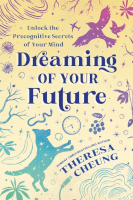 This book shows you how to harness your precognitive abilities while you sleep, which will give you a heads-up for tomorrow. Leading dream decoder Theresa Cheung offers simple precognition-boosting methods you can easily incorporate into your daily routine.
Featuring numerous exercises and a detailed directory of symbols divided into twenty themes, Dreaming of Your Future is far beyond a standard dream dictionary. It provides practices for mental time travel, memory games, making predictions, staying motivated, and much more.
For more info and/or to order this book, click here. Also available as a Kindle edition, Audiobook, and Audio CD.
Also available for purchase on Bookshop.org.
About the Author
Theresa Cheung is a modern mystic and Sunday Times bestselling dreams, spiritual and paranormal author. Since leaving King’s College, Cambridge University with a degree in Theology and English she has written numerous bestselling books and encyclopaedias which have been translated into dozens of different languages. Two of her paranormal titles reached The Sunday Times top ten and her international bestseller, The Dream Dictionary, regularly bounces to number 1 on the Amazon dreams bestsellers chart. Her mission and her passion is to make spirituality and the paranormal more credible, engaging and mainstream. Visit her website at www.theresacheung.com