
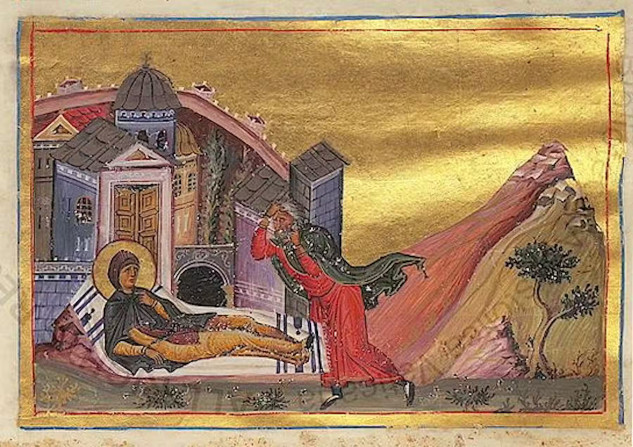
Euphrosyne of Alexandria. Anonymous via Wikimedia Commons
In This Article
- How do modern Christian lawmakers use faith to restrict trans rights?
- What evidence exists for transgender saints in Christian history?
- Why were these saints revered despite gender nonconformity?
- How does medieval theology frame gender and holiness?
- What can we learn from the life of Joseph of Schönau?
Christianity’s Forgotten Transgender Saints: 1,000 Years of Gender Defiance
by Sarah Barringer, University of Iowa
Several Republican-led states have restricted transgender rights: Iowa has signed a law removing civil rights protection for transgender people; Wyoming has prohibited state agencies from requiring the use of preferred pronouns; and Alabama recently passed a law that only two sexes would be recognized. Hundreds of bills have been introduced in other state legislatures to curtail trans rights.
Earlier in the year, several White House executive orders pushed to deny trans identity. One of them, “Eradicating Anti-Christian Bias,” claimed that gender-affirming policies of the Biden administration were “anti-Christian.” It accused the Biden Equal Employment Opportunity Commission of forcing “Christians to affirm radical transgender ideology against their faith.”
To be clear, not all Christians are anti-trans. And in my research of medieval history and literature, I found evidence of a long history in Christianity of what today could be called “transgender” saints. While such a term did not exist in medieval times, the idea of men living as women, or women living as men, was unquestionably present in the medieval period. Many scholars have suggested that using the modern term transgender creates valuable connections to understand the historical parallels.
There are at least 34 documented stories of transgender saints’ lives from the early centuries of Christianity. Originally appearing in Latin or Greek, several stories of transgender saints made their way into vernacular languages.

Transgender saints
Of the 34 original saints, at least three gained widespread popularity in medieval Europe: St. Eugenia, St. Euphrosyne and St. Marinos. All three were born as women but cut their hair and put on men’s clothes to live as men and join monasteries.
Eugenia, raised pagan, joined a monastery to learn more about Christianity and later became abbot. Euphrosyne joined a monastery to escape an unwanted suitor and spent the rest of his life there. Marinos, born Marina, decided to renounce womanhood and live with his father at the monastery as a man.
These were well-read stories. Eugenia’s story appeared in two of the most popular manuscripts of their day – Ælfric’s “Lives of Saints” and “The Golden Legend.” Ælfric was an English abbot who translated Latin saints’ lives into Old English in the 10th century, making them widely available to a lay audience. “The Golden Legend” was written in Latin and compiled in the 13th century; it is part of more than a thousand manuscripts.
Euphrosyne also appears in Ælfric’s saints’ lives, as well as in other texts in Latin, Middle English, and Old French. Marinos’ story is available in over a dozen manuscripts in at least 10 languages. For those who couldn’t read, Ælfric’s saints’ lives and other manuscripts were read aloud in churches during service on the saint’s day.
A small church in Paris built in the 10th century was dedicated to Marinos, and relics of his body were supposedly kept in Qannoubine monastery in Lebanon.
This is all to say, a lot of people were talking about these saints.
Holy transness
In the medieval period, saints’ lives were less important as history and more important as morality tales. As a morality tale, the audience was not intended to replicate a saint’s life, but learn to emulate Christian values. Transitioning between male and female becomes a metaphor for transitioning from pagan to Christian, affluence to poverty, worldliness to spirituality. The Catholic Church opposed cross-dressing in laws, liturgical meetings and other writings. However, Christianity honored the holiness of these transgender saints.
In a 2021 collection of essays about transgender and queer saints in the medieval period, scholars Alicia Spencer-Hall and Blake Gutt argue that medieval Christianity saw transness as holy.
“Transness is not merely compatible with holiness; transness itself is holy,” they write. Transgender saints had to reject convention in order to live their own authentic lives, just as early Christians had to reject convention in order to live as Christians.
Literature scholar Rhonda McDaniel explains that in 10th-century England, adopting the Christian values of shunning wealth, militarism and sex made it easier for people to go beyond strict ideas about male and female gender. Instead of defining gender by separate male and female values, all individuals could be defined by the same Christian values.
Historically and even in contemporary times, gender is associated with specific values and roles, such as assuming that homemaking is for women, or that men are stronger. But adopting these Christian values allowed individuals to transcend such distinctions, especially when they entered monasteries and nunneries.
According to McDaniel, even cisgender saints like St. Agnes, St. Sebastian and St. George exemplified these values, exhibiting how anyone in the audience could push against gender stereotypes without changing their bodies.
Agnes’ love of God allowed her to give up the role of wife. When offered love and wealth by men, she rejected them in favor of Christianity. Sebastian and George were powerful Roman men who were expected, as men, to engage in violent militarism. However, both rejected their violent Roman masculinity in favor of Christian pacifism.
A life worth emulating
Although most saints’ lives were written primarily as morality tales, the story of Joseph of Schönau was told as both very real and worthy of emulation by the audience. His story is told as a historical account of a life that would be attainable for ordinary Christians.
In the late 12th century, Joseph, born female, joined a Cistercian monastery in Schönau, Germany. During his deathbed confession, Joseph told his life story, including his pilgrimage to Jerusalem as a child and his difficult journey back to Europe after the death of his father. When he finally returned to his birthplace of Cologne, he entered a monastery as a man in gratitude to God for returning him home safely.
Despite arguing that Joseph’s life was worth emulating, the first author of Joseph’s story, Engelhard of Langheim, had a complicated relationship with Joseph’s gender. He claimed Joseph was a woman, but regularly used masculine pronouns to describe him.
Even though Eugenia, Euphrosyne and Marinos’ stories are told as morality tales, their authors had similarly complicated relationships with their gender. In the case of Eugenia, in one manuscript, the author refers to her with entirely female pronouns, but in another, the scribe slips into male pronouns.
Marinos and Euphrosyne were also frequently referred to as male. The fact that the authors referred to these characters as male suggests that their transition to masculinity was not only a metaphor, but in some ways just as real as Joseph’s.
Based on these stories, I argue that Christianity has a transgender history to pull from and many opportunities to embrace transness as an essential part of its values.
Sarah Barringer, Ph.D. Candidate in English, University of Iowa
This article is republished from The Conversation under a Creative Commons license. Read the original article.

Related Books:
Prayer Journal for Women: 52 Week Scripture, Devotional & Guided Prayer Journal
by Shannon Roberts and Paige Tate & Co.
This book offers a guided prayer journal for women, with weekly scripture readings, devotional prompts, and prayer prompts.
Click for more info or to order
Get Out of Your Head: Stopping the Spiral of Toxic Thoughts
by Jennie Allen
This book offers insights and strategies for overcoming negative and toxic thoughts, drawing on biblical principles and personal experiences.
Click for more info or to order
The Bible in 52 Weeks: A Yearlong Bible Study for Women
by Dr. Kimberly D. Moore
This book offers a yearlong Bible study program for women, with weekly readings and reflections, study questions, and prayer prompts.
Click for more info or to order
The Ruthless Elimination of Hurry: How to Stay Emotionally Healthy and Spiritually Alive in the Chaos of the Modern World
by John Mark Comer
This book offers insights and strategies for finding peace and purpose in a busy and chaotic world, drawing on Christian principles and practices.
Click for more info or to order
The Book of Enoch
translated by R.H. Charles
This book offers a new translation of an ancient religious text that was excluded from the Bible, offering insights into the beliefs and practices of early Jewish and Christian communities.
Click for more info or to order
Article Recap
Transgender saints in Christian history—like Marinos, Eugenia, and Joseph of Schönau—show that living beyond gender binaries was once considered an act of divine devotion. These stories were widely shared, respected, and canonized. Revisiting this history counters today's political use of Christianity to restrict trans rights and reminds us that faith, at its best, transcends the limitations of gender.
#TransgenderSaints #ChristianHistory #FaithBeyondGender #MedievalSaints #HolyRebels #QueerChristianity #TransHistory


















.jpg)