Can You Really Change the World Starting With One Choice?
The world feels broken, but what if the solution isn’t out there—it’s within you? Every thought, every reaction, every choice shapes…

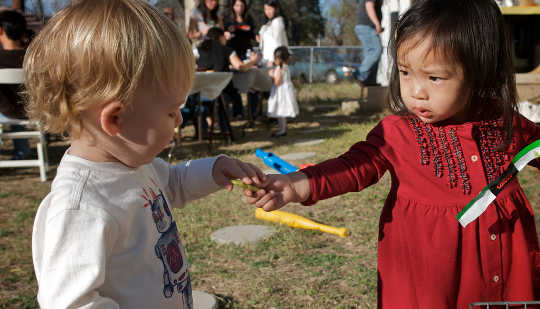
 Empathy, the ability to understand others and feel compassion for them, is arguably the most defining human quality – setting us apart from smart machines and even other animals. Without it, we couldn’t function in social areas such as the schools, court rooms and office workplaces that are the cornerstones of our society.
 "There is a belief that young kids can self-regulate their food intake," says Barbara Rolls. "This study shows those signals are really easy to override."
 Should a teacher reward a whole class for the good deeds of one student? What about the other side of the discipline picture: should a whole class be punished for the misdeeds of just a few students?
 We typically think of writing as something that is out of reach for preschool children. After all, young children can’t write recognizable letters, and they can’t spell words.
 In a study titled “Stress in America,” commissioned by the American Psychological Association, it was found that 30 percent of teens reported feeling overwhelmed, depressed, or sad as a result of stress. Almost 25 percent said they skipped meals because of stress. Almost one-third of teens say that stress often brings them to the verge of tears...
 A stagnant nation, despairing over the death of education . . . by the Great Cat, why? Have we not learned that school kills? The nation ought to be raving joyful for the death of its failed system of diplomas and degrees, raving delighted at the greening of this grand new culture, the Passionate Self-Educated.
 A new study is the first in more than 20 years to look at long-term outcomes after early intensive autism intervention. Therapy began when children were 18 to 30 months old and involved therapists and parents working with children at home for more than 15 hours each week for two years.
 Some parents think it’s their job to make their children happy and to think for them – but this is not true. It’s not the parents’ job to think for their children or to make them happy. It’s impossible for one human being to think for another human being or to make another human being happy.
 At the end of the school year, districts often send stacks of books home with their students in the hopes of combating the “summer slide” in reading skills. This type of literacy loss hits low-income students particularly hard.
 A lot of previous research has suggested that young people living in single-mother households are at an educational disadvantage. But our new study looking at the lives of 10,000 teenagers suggests that this is not true. A stable family, even if it is a lone-parent one, is the best place to grow up.
 Children learn to lie from about the age of two. The first lies children learn to tell are denials of wrongdoing. From the age of three they also learn to tell “white” lies. But what can we do to encourage children to tell the truth?
 Why does a four-year-old play when a 14-year-old creates? It’s often argued that play is central to the lives of young children. Yet the play of older children and adults is often seen as leisure, escapism or even deviance. But there should not be such a binary division between what is educational and what is frivolous.
 As a family therapist, I often have the impulse to tell families to go home and have dinner together rather than spending an hour with me. And 20 years of research in North America, Europe and Australia back up my enthusiasm for family dinners. It turns out that sitting down for a nightly meal is great for the brain, the body and the spirit.
 A new study finds a link between a good night’s sleep for school-aged kids and better performance in math and languages specifically—subjects that are powerful predictors of later learning and academic success.

In pregnancy and in some cases even before, quite a high proportion of mothers believe they have been in contact with their unborn children. Some of the women studied found their bodies picking up their unborn babies' feelings. "Every once in a while, I have a feeling but I don't know where it comes from. And then I realize that I am not the one having the feeling."

Indigos process their emotions differently than non Indigos because they have high self-esteem and strong integrity. They can read you like an open book and quickly notice and neutralize any hidden agendas or attempts to manipulate them, however subtly.

Teenagers' opinions about when violence is acceptable or not can be influenced by the way they perceive men and women and the relationships between them. Simply telling young people that violence is wrong won’t stop it happening.

To examine a person’s difficulties is to enter into the psychological atmosphere of his or her family. We are marked by their characteristics, but also by their insane ideas, their negative feelings, their inhibited desires, and their destructive acts. All problems have their roots in the family tree.

When you have more than one child, the importance of fairness seems to trump all other considerations, including self-interest. Give a child £1 and she will be happy. But if she finds out that her sibling got £1.50, she will be angry. Take the money away from both and she will be satisfied. Both have lost, but...

Daily interactions require bargaining, be it for food, money or even making plans. These situations inevitably lead to a conflict of interest as both parties seek to maximise their gains. To deal with them, we need to understand the other person’s intentions, beliefs and desires and then use that to inform our bargaining strategy.

Bullying in schools has been recognized as a serious and pervasive problem now for at least two decades. There is now also evidence that traditional forms of bullying in schools have decreased modestly over the last decade or so. This is very likely due to the increase in work to prevent bullying...

As a mother, I have made life choices that can’t always include everything my children want—like hiking the Adirondacks. Here’s how I learned to overcome the guilt...

The secret to learning self-awareness, cooperation, and other “social and emotional learning” skills lies in experience, not in workbooks and rote classroom exercises.