
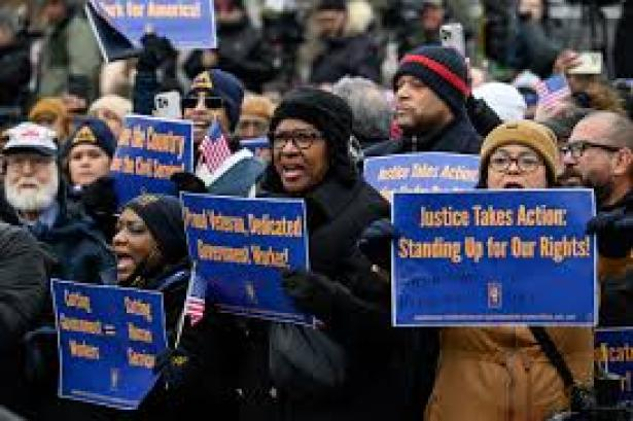
Black women are being pushed out of the very jobs that once anchored their families and communities. Government work, long considered a ladder to security and dignity, is now being dismantled piece by piece. This isn’t just an economic shift, it’s a structural assault on a group that has historically borne the brunt of America’s inequities while holding the country together in times of crisis. What happens when the backbone is deliberately weakened? We all stumble.
In This Article
- Why are Black women losing jobs in the federal workforce?
- How did Trump’s cuts target agencies with high Black women staff?
- What historical role did government jobs play in Black women’s security?
- How does this crisis impact families and communities nationwide?
- Why does this issue signal a broader economic warning for all Americans?
Black Women Jobs Lost in Federal Workforce Purge Under Trump
by Alex Jordan, InnerSelf.comFor decades, federal employment offered Black women a rare avenue into the middle class. These jobs were not glamorous, but they were stable. They came with pensions, health insurance, and protections that shielded workers from the worst of private-sector discrimination.
Now, those protections are unraveling. The Trump administration’s cuts to agencies like the Department of Education and USAID hit hardest where Black women are most represented. This is not coincidence. It is targeted policy disguised as budget efficiency.
Statistics can sound dry until you dig into their meaning. More than 306,000 Black women have lost their federal jobs since February. That figure represents not only lost wages but also stripped retirement security, health benefits, and the ability to support children through college.
By contrast, white men’s employment in the same period has ticked upward. The disparity is not accidental; it reflects deliberate political choices about who gets to participate in the economy and who gets pushed aside.

A Historical Pathway Undone
Why did so many Black women seek work in government in the first place? The answer is rooted in America’s history of exclusion. After slavery and through the Jim Crow era, private companies routinely shut their doors to Black applicants or paid them poverty wages.
The federal government, pressured by civil rights struggles, became the first major employer to open doors widely. For many Black women, civil service became the most reliable path to upward mobility. That hard-fought pathway is now being demolished in a matter of years.
Job loss doesn’t exist in a vacuum. A Black woman who loses her position at the Department of Education isn’t just an individual statistic, she is also a mother, a daughter, a caregiver, and often the financial anchor of her family.
When she loses her paycheck, her children lose access to stable housing and higher education opportunities. Her elderly parents may lose caregiving support. The ripple expands outward, destabilizing entire communities. Economists warn that when the canary in the coal mine collapses, the whole system is next.
The DEI Rollback
The public sector is not the only arena where Black women are being squeezed out. In the private sector, diversity, equity, and inclusion roles, positions disproportionately held by Black women, are being eliminated as corporations bow to political pressure.
These positions were more than symbolic; they represented the institutional acknowledgment that systemic inequity required systemic correction. Rolling them back sends a blunt message: progress was conditional, and the conditions have expired.
Economist Jessica Fulton calls this dynamic a warning sign for the entire economy. When Black women, often considered the most vulnerable group in the labor force, see their unemployment spike, it signals fragility that will eventually spread.
Black women are, in Fulton’s words, a canary in the coal mine. Ignoring their job losses means ignoring the warning lights on the dashboard. Eventually, the engine seizes, and everyone pays the price.
From Structural Racism to Structural Collapse
This isn’t just about race or gender, though those dimensions are undeniable. It is also about dismantling public infrastructure. When cuts gut the Department of Education by nearly half, we are left with fewer teachers, fewer administrators, and weaker support for students nationwide.
When USAID’s minority workforce is hollowed out, America’s global capacity for humanitarian leadership shrinks. This isn’t budgetary prudence, it’s sabotage dressed in fiscal language. And it leaves behind a weaker, less equitable society.
History is full of lessons, though we rarely heed them. After Reconstruction, Black workers were systematically pushed into sharecropping arrangements that left them poorer at the end of the year than at the beginning. The dismantling of federal jobs feels like a modern echo.
The structures that once provided stability are being pulled down, leaving families to scramble in an economy that offers fewer protections and more exploitation. The cycle is familiar, and so are its consequences: inequality entrenched and hope eroded.
Why This Matters for Everyone
It’s tempting for some to dismiss these numbers as “someone else’s problem.” But when over 300,000 workers are removed from the economy, consumer spending falls. Families buy less, businesses see fewer customers, and local tax bases shrink.
This isn’t just about Black women, it’s about the very functioning of the American economy. Cutting them out of the workforce isn’t merely unjust; it is economically foolish. An economy cannot thrive by discarding one of its most productive groups.
Employment is more than a paycheck. It is access to healthcare, retirement savings, social security contributions, and the stability that allows communities to grow. Strip away those jobs, and the losses cascade. Hospitals see more uninsured patients. Retirement funds shrink.
Children lose educational opportunities. The attack on Black women in the workforce is also an attack on the broader social safety net, and eventually, it erodes everyone’s quality of life.
Resistance and Resilience
Despite these setbacks, resistance is building. Communities are organizing, unions are speaking out, and coalitions are forming. History shows that progress has never been gifted; it has always been won through struggle.
If federal jobs were once secured through protest and advocacy, they can be protected again. But that requires recognizing the stakes. This isn’t only about employment statistics, it’s about whether America chooses equity or exclusion, resilience or regression.
Framing this as an issue of budget cuts misses the point. This is about who belongs in America’s future. By stripping Black women from the workforce, the message is clear: their contributions are disposable. But when Black women thrive, families thrive, communities thrive, and economies thrive. The inverse is also true, when Black women are pushed out, society fractures. The choice before us is stark: inclusion or collapse.
Solidarity isn’t just a slogan. It is a strategy for survival. Recognizing that Black women’s job losses foreshadow broader instability means building coalitions that cut across race, gender, and class. Collective bargaining, union strength, and political advocacy are not luxuries, they are necessities. The warning lights are flashing, and the time for action is now.
About the Author
Alex Jordan is a staff writer for InnerSelf.com
Recommended Books
The Color of Law
This book by Richard Rothstein examines how government policies deliberately created and sustained racial segregation, laying bare the structural racism still visible today.
https://www.amazon.com/exec/obidos/ASIN/1631494538/?tag=innerselfcom
Sister Citizen
Melissa V. Harris-Perry explores the stereotypes that distort Black women’s political behavior and citizenship, linking personal narratives to systemic inequities.
https://www.amazon.com/exec/obidos/ASIN/0300165412/?tag=innerselfcom
The Sum of Us
Heather McGhee reveals how racism costs everyone, not just people of color, and makes the case for a more inclusive economy that benefits all.
https://www.amazon.com/exec/obidos/ASIN/0525509569/?tag=innerselfcom
Article Recap
Black women jobs in the federal workforce are disappearing under Trump-era cuts, stripping away stability, widening inequality, and weakening the economy. This crisis is not confined to one demographic, it threatens families, communities, and the broader American economy. Recognizing the warning signs and building solidarity is essential for turning back the tide of exclusion and rebuilding a more equitable society.
#BlackWomenJobs #FederalWorkforce #JobLoss #EconomicJustice #TrumpCuts #WorkplaceEquality #SystemicRacism